AI did not kill content marketing; it killed average content. (spoiler alert: most content is average..but buyers are not).
AI in B2B Marketing gives teams a production advantage. They use it to publish more blogs, more landing pages, and more “thought leadership.” They move quickly, produce more, and celebrate high volume. Yay!…but…AI should not be seen as a content multiplier. Instead, it acts as a credibility filter and currently filters out most B2B content.
If you are responsible for marketing, product marketing, or content, this shift should be a concern for you. AI now influences discovery before a buyer even engages with sales. If your content lacks depth, AI can summarize it away.
The Discovery Layer Changed
Buyers don’t start their research journey on your website, they begin with AI tools. They ask platforms like ChatGPT and Grok to compare different vendors, read Google AI Overviews instead of clicking through a list of search results, and use Perplexity to validate claims. In fact, they complete 70–80% of their research before even filling out a form.
AI search is acting as an intermediary between you and potential customers, and this changes everything. Remember, AI excels at three key tasks:
- Clustering similar content.
- Compressing generic messaging.
- Providing specific, structured, and technical answers.
If your content is similar to other published content, AI will treat it in the same way.
AI in B2B Marketing: Why Most Teams Are Reacting Incorrectly
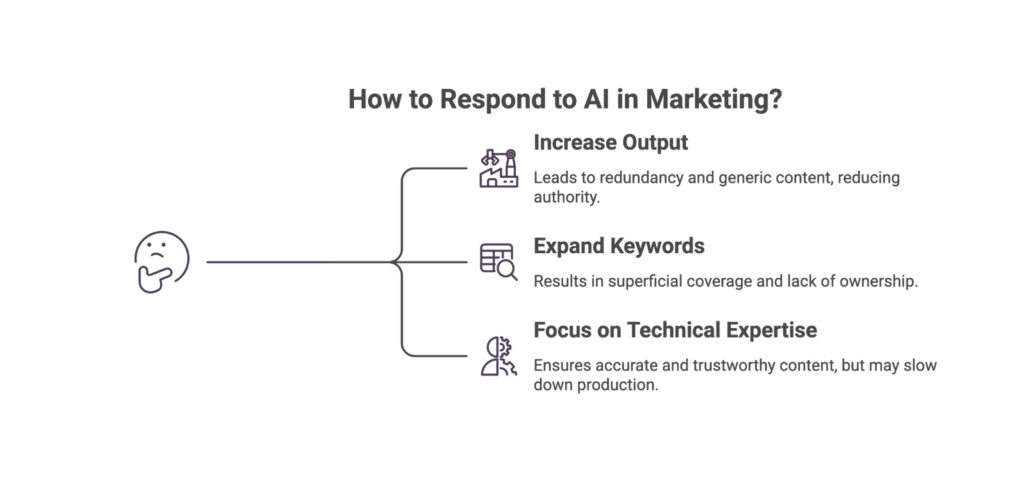
Many marketing leaders react to AI with speed. They increase output, automate blog production, and expand keyword coverage. This response appears logical but it’s misguided.
The Volume Trap
When every company uses AI to write similar articles, content becomes pattern-based. AI systems detect that pattern and summarize it into one generic answer. Your 1,200-word blog becomes one sentence in an overview.
More content doesn’t increase authority; it increases redundancy.
The Keyword Expansion Illusion
Content teams chase adjacent keywords:
- “AI for SaaS”
- “AI marketing trends”
- “Future of AI in B2B”
- “AI-driven personalization”
However, they tend to provide superficial coverage of topics, which leads to a lack of ownership over any specific area. Authority in a subject doesn’t stem from a wide range of topics but rather from a deep understanding of a select few.
The Technical Writing Gap
Marketing agencies move fast, but they lack deep technical expertise. They produce clean, well-structured content, yet often overlook the architectural nuance and real-world trade-offs that matter to technical buyers. The output looks polished, but it rarely earns trust.
Internal engineers sit on the opposite end. They understand the product in depth, know what breaks, what scales, and what fails in production. But they don’t have time to write consistently. When they do, content slows down and marketing momentum stalls. The result is accurate insight delivered too late to shape the pipeline.
AI-generated blogs widen this gap. Marketing teams publish at extreme speed, but recycle patterns and surface-level insights. AI now exposes this divide. If your content doesn’t answer real implementation questions, it won’t rank, surface in AI summaries, or convert serious buyers.
What AI Actually Rewards?
AI values specificity, clarity, and real-world evidence. It doesn’t value the word count or keyword stuffing. AI is looking for what your real readers are looking for.

Technical Specificity
Modern buyers ask:
- What breaks at scale?
- How does this integrate with my stack?
- What trade-offs should I expect?
- What does deployment look like in production?
If your content doesn’t address these questions, AI will not cite you. Specific beats general, always.
Structured Authority
AI prefers content it can parse and trust. It rewards clarity and structure over vague storytelling. That means using clear subheadings, giving direct answers to specific questions, and including FAQ sections that address real objections.
It favors comparison tables, deployment guides, and well-defined use cases because they reduce ambiguity. Strong structure signals authority. And in an AI-shaped discovery layer, structure increases visibility.
Practitioner Insight
AI models rely on established patterns, while practitioner content breaks those patterns. When engineers discuss real-world failures, edge cases, and trade-offs, they provide insights that generic content lacks.
These insights create a distinct signal that sets their work apart. If your content could easily be produced by anyone, AI will likely treat it the same way.
The New Content Moat: Credibility Density
In the AI-driven funnel, credibility builds on itself. A single deep technical whitepaper can outperform ten shallow blog posts. One deployment guide can generate more leads than months of generic SEO content. This concept is known as credibility density.
High-performing teams adopt a unique approach to content creation. They align their content directly with genuine sales objections by interviewing customers and engineers before writing anything. Their focus is on addressing long-term technical challenges that are real barriers to purchase. Rather than chasing trends, they develop topic clusters centered around implementation, integration, and operational realities.
They publish fewer pieces of content, but each one is ready for production. Every piece serves a specific purpose within the sales funnel. They treat content the same way they treat products. They define requirements, align stakeholders, and proceed with purpose.
How AI Has Raised the Bar for CMOs
AI has compressed the top of the funnel. Buyers now validate vendors before they ever speak to sales. They compare options using AI tools, scan technical discussions, and look for evidence before engaging. At the same time, sales teams expect marketing to handle objections early. They want content that answers hard questions before the first call.
Your content must build trust with technical buyers from the start. It must equip sales with credible, detailed assets and shorten sales cycles by addressing deployment challenges, trade-offs, and integration concerns upfront. Fluff no longer survives first contact.
Run a simple test. Would a senior engineer trust this content? Would your sales engineers stop rewriting it? Does it address real deployment friction? If the answer is no, AI won’t reward it, and neither will your buyers.
The Cost of Getting This Wrong
If you scale generic content, AI will collapse your differentiation. Your messaging will blend into the category. Traffic may spike and drop without warning as algorithms shift. Sales teams will stop trusting marketing assets and start rewriting them. Customer acquisition costs will rise while pipeline momentum slows.
You may still see activity metrics improve. You may publish more. You may rank for more keywords. But a lasting revenue impact won’t follow. In an AI-mediated market, the gap between activity and actual pipeline is actually getting wider.
The Strategic Shift You Must Make
AI does not replace content strategy; it enforces discipline. You need to transition from:
- Content volume to content authority
- Keyword coverage to problem ownership
- Marketing copy to technical credibility
This is why you need a strong collaboration between marketers and industry practitioners. You need content created by, and for, individuals who understand both the product and the buyer.
Conclusion: AI Is a Credibility Amplifier
AI is not your content engine; it’s your filter. It shapes what buyers see first, which vendors appear credible, and which answers rise to the top. AI scans for depth, structure, and clarity. It compresses repetition and rewards substance.
If your strategy centers on scale alone, AI will reduce you to a generic summary. If your strategy centers on technical depth and precision, AI will amplify your authority. The future of B2B marketing belongs to teams that treat content as infrastructure, not decoration. You don’t need more content; you need content that survives AI.
If you want to pressure-test your current strategy and build a content engine that engineers trust and AI surfaces, book a free 30-minute advisory call. Let’s build credibility that converts.