
I’m a little old school, so I thought you may enjoy going into the wayback machine with me to learn about some surprising origins for SEO (Search Engine Optimization) and GEO (Generative-search Engine Optimization). When we say things like “everything old is new again”, it’s for a good reason.
There’s a little marketing magic (literally) down below too. Let’s jump in!
The OG SEO – Yellow Pages
Before the internet, consumers turned to the Yellow Pages for local services. Businesses fought for top placement in these thick directories, paying premiums for bold listings or category dominance. This analog competition for visibility closely parallels the high-stakes battles in modern search engine results pages (SERPs).
The Yellow Pages functioned as the world’s first mass-market directory search engine, generating over $10 billion in annual ad revenue by the 1970s (equivalent to about $50 billion today, adjusted for inflation). Historical Nielsen data indicates up to 70% of local searches began there. Google digitized these dynamics, yet core principles of user intent, keyword competition, and visibility tactics persist.
For CMOs in software companies navigating tight budgets and fierce competition, understanding SEO history reveals enduring strategies for organic growth. These origins highlight trends in marketing evolution, from print-era hustles to algorithm-driven search, offering insights into building topical authority without gimmicks.
Alphabetical Exploits: Keyword Stuffing’s Print Predecessor
One classic Yellow Pages tactic involved alphabetical hacks. Businesses rebranded with prefixes like “AAA Cleaning” or “A-1 Absolute” to claim the top spots in “A” categories. Users scanning sections such as “Observability Tools” or “Kubernetes Monitoring” would see these listings first. I call this the “AAA Aardvark Hotel” method.
You can see how “AC Landscapes” took advantage of this tactic:
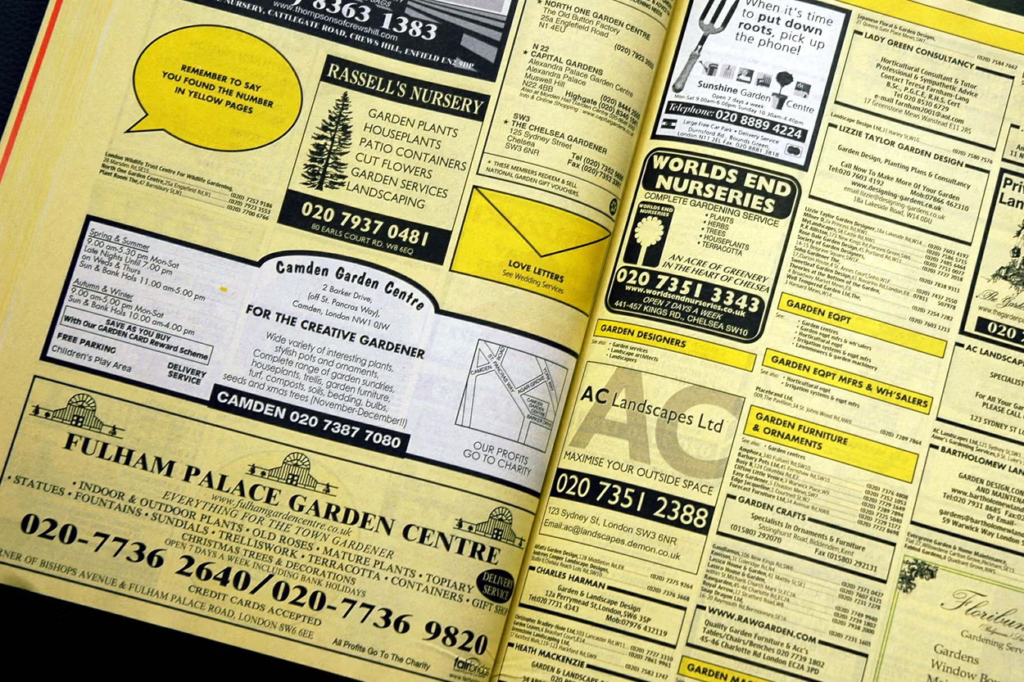
This echoes early SEO practices, including exact-match domains (EMDs) and keyword-stuffed URLs prevalent in the 2000s. Sites like “bestcheapobservability.com” surged in rankings as search engines favored literal keyword matches. Google’s 2012 EMD update addressed these manipulations, similar to Yellow Pages publishers introducing verification rules.
Search now emphasizes semantic relevance and topical clusters around queries like “affordable observability for microservices.” User intent remains constant across eras, rewarding depth over superficial tricks.
Bold Listings and Jumbo Ads: The Roots of Title Tags and Rich Snippets
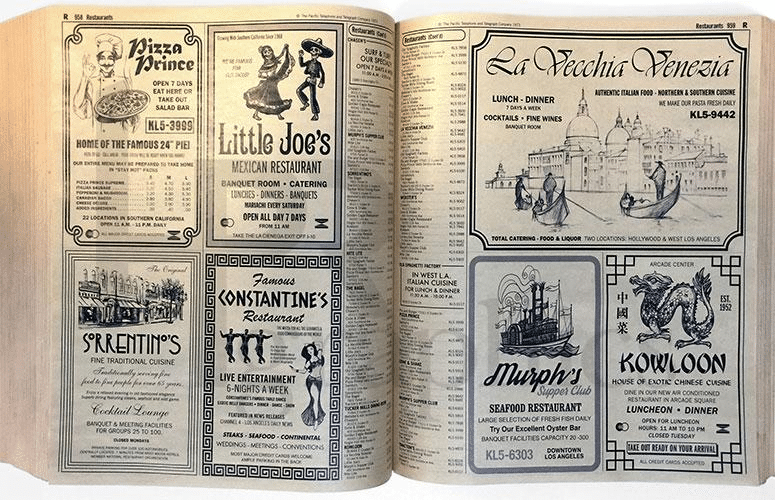
Yellow Pages entries varied in prominence. Basic black-and-white lines offered minimal exposure, while bold text increased visibility. Jumbo ads dominated page space, and color borders created standout appeal. Advertisers A/B tested these elements, with visuals boosting inquiries, according to period ad reports.
Modern equivalents include title tags as bold print, meta descriptions as teasers, and rich snippets as jumbo ads. Compelling titles under 60 characters incorporating keywords can increase clicks. Schema.org structured data adds stars, carousels, or other enhancements, lifting click-through rates (CTR) by meaningful margins in B2B tech sectors.
Organic traffic accounts for the majority of website visits, making these tactics essential for you to gain visibility. Precision in the implementation is key, because errors in structured data are common. User-aligned messaging prevents high bounce rates.
Category Shopping: Long-Tail Keywords in Analog Form
User behavior showed that they were bypassing broad sections, heading to precise subcategories like “Observability, Emergency SLO Alerting” or “Kubernetes Monitoring, Repair.” Businesses secured multiple entries to capture intent-specific traffic, achieving higher conversion rates compared to generic listings.

This strategy mirrors long-tail keywords in digital search. Phrases such as “emergency SLO alerting for frozen Kubernetes clusters” exhibit lower search volume but higher conversions than broad terms like “observability tools”. With BERT and MUM models, long-tails represent a significant portion of queries.
For CMOs competing against incumbents, intent-matching through content hubs proves efficient. Structures spanning awareness topics (“signs of observability gaps”) to decision-stage queries (“24/7 Kubernetes monitoring costs”) emulate this category arbitrage, aligning with rising specificity in search behavior.
Cross-References and Multiple Listings: From Doorway Pages to Internal Linking
Advertisers used cross-references (“See main ad under Observability”) or duplicate listings to direct traffic to premium spots. Publishers tolerated these for revenue, until abuses prompted restrictions.
In SEO, these tactics evolved into doorway pages, penalized after Google’s Florida update in 2003. Ethical successors include internal linking and silo architecture. Pillar pages on topics like “SEO for SaaS GTM” link to clusters such as “long-tail keyword mapping,” boosting search referral traffic for sites with robust internal linking with high-intent content.
Strong internal structures signal authority, helping software marketers scale visibility amid limited resources.
Visual Tricks and Icons: Predecessors to Schema Markup
Icons in Yellow Pages, such as dashboards for observability or alert bells for monitoring, provided instant recognition. Thumb tabs and colors improved recall. The use of visuals to enhance the search and discovery were the next bastion to catch the searcher’s eye.
Today’s parallels are found in things like featured snippets and knowledge panels. JSON-LD Schema for FAQPage or HowTo schemas generates accordions and step-by-steps. For LocalBusiness, it enables zero-position results, where snippets capture clicks relative to top organic positions.
Visual cues tap into timeless psychology, now amplified by rising visual search trends.
Here’s a quick example of effective visual manipulation. (the secret is in the conclusion below).
From Manipulation to User Intent: The Ethical Evolution
Scandals involving fake categories in Yellow Pages spurred changes in how they would validate your placement and the statements made in your ad. In the digital version of life now, Google prioritizes E-E-A-T (Experience, Expertise, Authoritativeness, Trustworthiness).
This is particularly important for YMYL (Your Money or Your Life) topics requiring trust signals like real case studies and validation of data. The same evaluations are used to surface validated, data-driven content above others.
Timeless principles endure: map user intent (informational or transactional), compete through quality, and measure outcomes. Yellow Pages leaders maintained higher market share through economic downturns. Today, Core Web Vitals serve as key signals, with fast Largest Contentful Paint (LCP) correlating to better rankings.
Staying Ahead in the Digital Directory
These origins demystify search as an eternal auction of expertise. As generative engines and search experiences evolve toward more zero-click queries, preparation involves FAQ Schema and People Also Ask optimization to secure brand impressions in answer engines.
CMOs driving brand awareness and pipeline growth can apply these lessons to craft future-proof strategies. Behavioral psychology, from thumb-stopping icons to snippet heuristics, remains a constant. But more than anything, the content has to be worth reading.
Oh…one more thing…
Here’s the secret I mentioned earlier: If you don’t think that carefully planned use of visual cueing works, why did you remember the Jack of Spades and the Seven of Diamonds more than any other cards?