Technical buyers do not respond to hype. They want clarity, proof, and technical depth. As B2B products become more complex across AI, cloud infrastructure, DevTools, and cybersecurity, traditional marketing alone is no longer enough to earn their trust.
The truth is, it never was. Technical readers have a very distinct way to approach how they consume and get value from content. This has given rise to a new hybrid function inside modern tech companies: the Engineer Marketer.
An Engineer Marketer combines technical fluency with strategic storytelling. They understand how a product works at the architectural level, yet they can also translate that complexity into content, positioning, and narratives that resonate with developers, architects, and technical decision makers.
Now the questions we need to ask are: what they actually do, how the role differs from Product Marketing and DevRel, and why is this Engineer Marketing becoming essential in modern B2B tech teams?
What Is an Engineer Marketer?
An Engineer Marketer is a technical professional who combines engineering depth with marketing strategy to help complex products resonate with technical buyers. They understand how a product works at the system, architecture, and implementation level, and they translate that knowledge into clear, credible narratives that drive adoption and growth.
We sometimes call this TME (Technical Marketing Engineer). But the reason we are changing the name to Engineer Marketer is because of the primary focus: Engineering.
Engineer Marketers typically sit at the forefront of product use, mixed with some marketing, and developer engagement. Depending on the company structure, the role may live within:
- Product Marketing teams, supporting technical positioning and launches
- Developer Relations teams, with a stronger emphasis on strategic growth
- Growth or Demand Generation teams targeting technical audiences
- Early-stage startups often report directly to founders or the Head of Marketing
- Platform or Ecosystem teams within cloud and infrastructure companies
Because they operate in technical markets, Engineer Marketers primarily serve audiences that demand depth and clarity, including:
- Developers evaluating tools, APIs, and infrastructure
- Solutions architects assessing technical fit and scalability
- Technical founders building on platforms or integrating APIs
- Engineering leaders involved in purchasing decisions
- Technical sales teams that need credible enablement and demo materials
Why the Engineer Marketer Role Is Growing
The Engineer Marketer role is growing because the way technical products are bought has fundamentally changed.
Technical buyers are skeptical
Developers and architects do not rely on taglines or broad claims. They evaluate architecture, performance benchmarks, integration effort, and long-term scalability. If the messaging lacks technical depth, credibility is lost immediately.
Products are more complex than ever.
Modern B2B tools are rarely simple applications. They involve distributed systems, AI models, security layers, and multi-cloud environments. Explaining real value now requires someone who understands the underlying systems, not just the feature list.
Documentation is not enough by itself.
Docs explain how something works. They rarely explain why it matters, how it compares, or what trade-offs exist. Engineer Marketers bridge that gap by connecting technical detail to strategic context.
Trust matters more than hype in modern B2B.
In markets where buyers can test products instantly and compare alternatives in minutes, exaggerated marketing does more harm than good. Clear technical reasoning builds trust. Vague promises erode it.
This shift is especially visible in categories such as:
- DevTools, where developers expect real examples and working demos
- AI infrastructure, where buyers scrutinize latency, model performance, and cost trade-offs
- APIs and platforms, where integration depth and reliability determine adoption
- Cybersecurity, where technical validation and architecture clarity drive purchase decisions
As technical scrutiny increases, companies need people who can communicate with precision. That is why the Engineer Marketer role is expanding across modern B2B tech.
What Does an Engineer Marketer Actually Do?
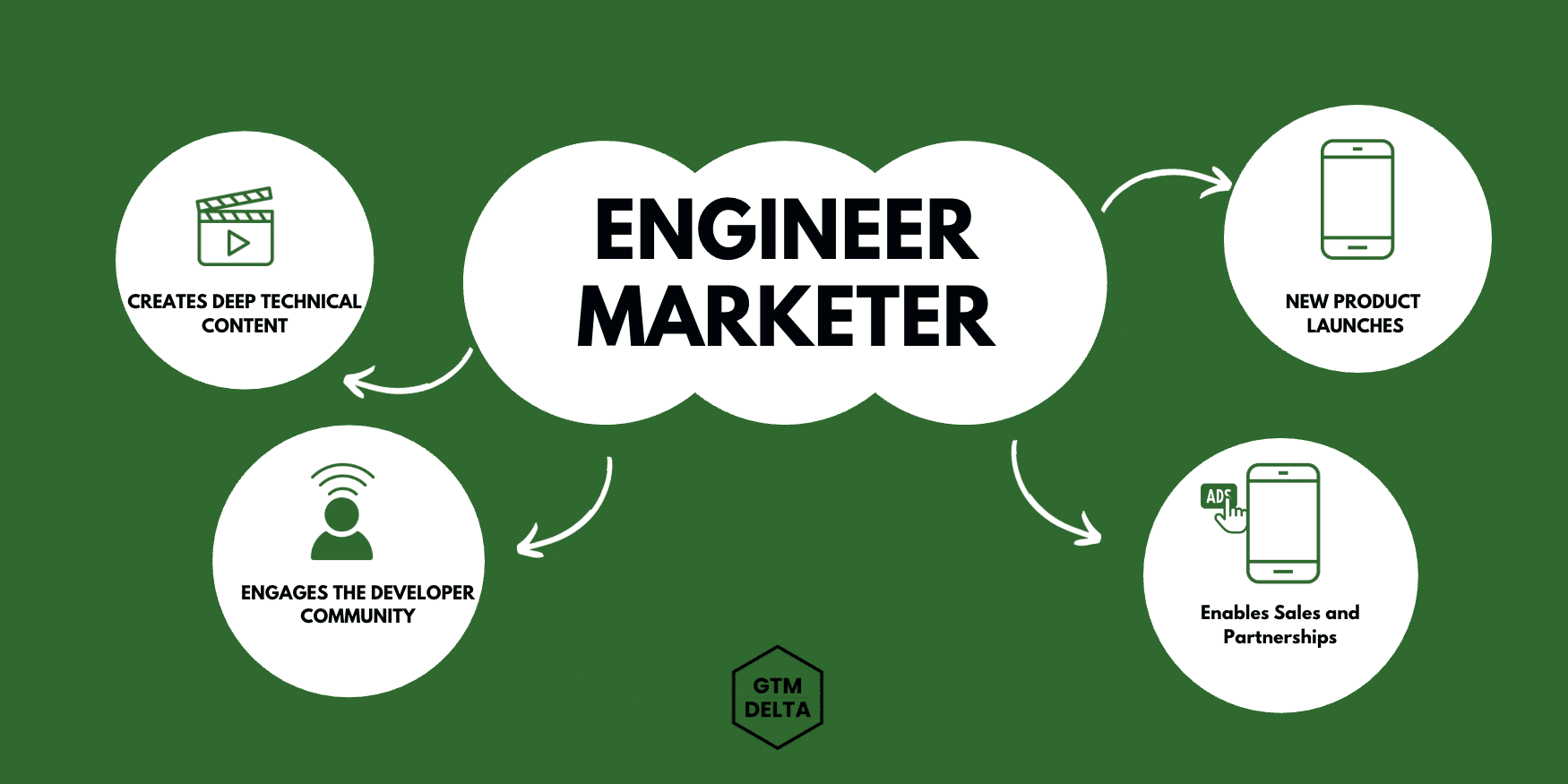
The Engineer Marketer role is execution-heavy. It requires having a deep understanding of product capabilities (aka features), and market impact, turning technical capability into growth assets (aka outcomes).
The outcomes are for both the Engineer Marketer and the reader/viewr. For the Engineer Marketing it is a growth lever to increase SEO presence, GEO placements, and overall authority on a subject. For the engineering reader or viewer, it’s a way to interact with the brand/product that is much more attuned to how they want to consume content. Less fluff, more action.
1. Creates Deep Technical Content
Engineer Marketers produce content that technical audiences respect and rely on. This goes beyond surface-level blogs and focuses on real substance, such as:
- Architecture breakdowns that explain system design and technical decisions
- Benchmark reports with transparent methodology and performance metrics
- GitHub demos that show real implementation, not theoretical use cases
- Whitepapers that align technical depth with strategic positioning
This type of content builds authority and reduces friction in technical evaluation.
2. Supports Product Launches
When new features ship, Engineer Marketers ensure they are introduced with clarity and credibility.
They focus on:
- Turning feature releases into technical narratives that explain why the change matters
- Explaining trade-offs, limitations, and real-world implications instead of listing benefits
This helps technical buyers assess impact quickly and accurately.
3. Enables Sales and Partnerships
Engineer Marketers strengthen the technical side of revenue conversations.
Their work often includes:
- Building demo environments that showcase real-world scenarios
- Creating technical case studies grounded in implementation detail
- Leading customer-facing deep dives for complex prospects or partners
This shortens sales cycles and improves trust during technical validation.
4. Engages the Developer Community
Beyond content and launches, Engineer Marketers contribute to ongoing technical engagement.
This can include:
- Hosting webinars that explore product architecture or advanced use cases
- Running workshops that guide hands-on adoption
- Speaking at conferences on technical topics related to the product
- Creating developer-focused social content that educates rather than promotes
In each case, the goal is the same: earn credibility by combining technical substance with clear communication.
Engineer Marketer vs Product Marketer vs DevRel
These roles often overlap, but their focus and execution differ. Understanding the distinction helps clarify where the Engineer Marketer fits.
Engineer Marketer vs Product Marketer
The key difference lies in depth and orientation.
- Technical depth vs positioning breadth
Product Marketers focus on market positioning, segmentation, and competitive messaging. Engineer Marketers go deeper into architecture, implementation, and system-level detail. - Messaging vs implementation insight
Product Marketers craft the core narrative. Engineer Marketers validate and strengthen that narrative with technical substance, examples, and proof.
Engineer Marketer vs DevRel
The difference here is intent and primary objective.
- Community-first vs growth-first
DevRel prioritizes community building, advocacy, and long-term developer relationships. Engineer Marketers are more directly tied to adoption, pipeline support, and revenue impact. - External advocacy vs strategic enablement
DevRel represents the developer externally and brings feedback inward. Engineer Marketers enable launches, sales, and growth initiatives with technical credibility.
| Focus Area | Engineer Marketer | Product Marketer | DevRel |
| Technical Depth | High | Moderate | High |
| Core Objective | Growth through technical credibility | Market positioning and messaging | Community and advocacy |
| Content Type | Benchmarks, demos, deep dives | Messaging, launch assets, sales collateral | Tutorials, talks, community content |
| Revenue Alignment | Directly aligned | Directly aligned | Indirect but influential |
Core Skills of a Great Engineer Marketer
The role requires a balanced mix of technical competence and market awareness. The best Engineer Marketers are strong in a few core areas.
Technical Fluency
They do not need to be full-time engineers, but they must understand how modern systems work. This includes:
- APIs and integration patterns
- System architecture and infrastructure concepts
- Performance metrics such as latency, throughput, and scalability
- Technical trade-offs and design decisions
Without this foundation, credibility with technical buyers is difficult to establish.
Strategic, Technical Storytelling
Technical depth alone is not enough. Engineer Marketers must simplify without oversimplifying.
- Turning complexity into clarity
- Translating features into real business or engineering impact
They connect technical capability to meaningful outcomes.
Commercial Awareness
Engineer Marketers operate within revenue teams, so they need business context.
- Understanding the ideal customer profile
- Supporting clear market positioning
- Highlighting competitive differentiation
This ensures technical content aligns with growth goals.
Communication Depth
Strong communication is a core differentiator.
- Writing long-form technical content
- Explaining systems visually through diagrams or structured breakdowns
- Speaking confidently with developers, architects, and technical leaders
Final Words
The Engineer Marketer role matters now because B2B technology has changed. Buyers are more informed, products are more complex, and evaluation cycles are more technical than ever before. Surface-level messaging is easy to ignore. Depth earns attention.
The future of B2B tech marketing belongs to people who can both build and explain.
At GTM Delta, our Engineer Marketers combine technical fluency with strategic storytelling to help complex products resonate with technical buyers. From deep technical content and benchmark reports to launch support and ecosystem positioning, we bridge the gap between product and growth.
If you are selling to developers, architects, or technical founders and your messaging is not landing, it may be time to rethink how you communicate.
Book a strategy session with GTM Delta and see how Engineer Marketers can accelerate your technical growth.