
There’s a moment every founder of a deep-tech company remembers. You ship the first technical blog post or whitepaper. The metrics come back: 47 views, zero demo requests, and a polite note from your head of sales saying “SEs had to rewrite half of it.”
You realize the problem isn’t that your engineers can’t write. They can. The problem is they shouldn’t. And the agencies you tried before couldn’t, not because they’re bad at it by nature, but because they’ve never shipped production code in the domain they’re trying to explain.
This is the technical content dilemma. On one axis: accuracy and depth. On the other: content quality and efficiency. Traditional agencies sit in the bottom-left quadrant. Your own engineers sit in the top-right. Neither quadrant scales. Both cost you time, money, or credibility.
We built GTM Delta to occupy the impossible quadrant that actually works.
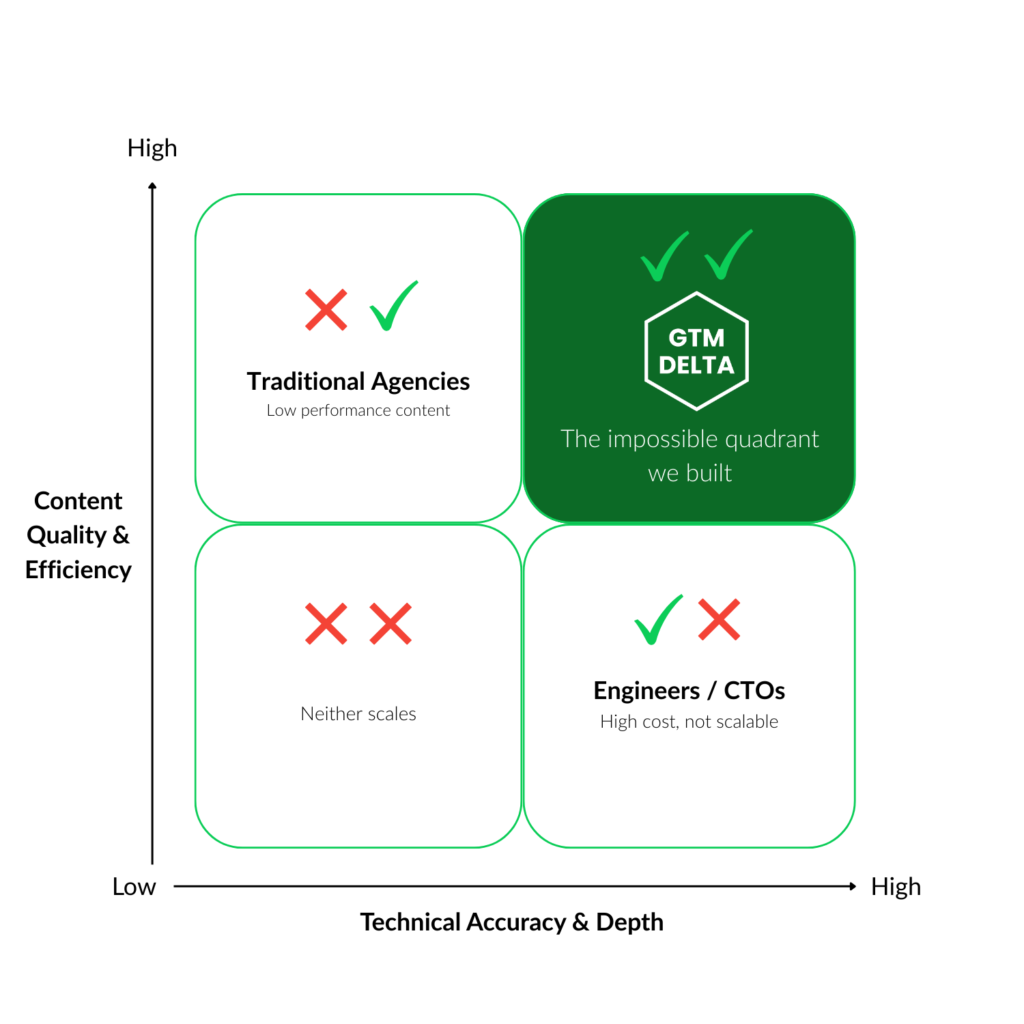
The insight is almost embarrassingly simple once you see it: the people best qualified to explain complex technology to sophisticated buyers are the same people who would be buying it if they weren’t busy building something else. Practicing engineers, scientists, and professors who still code, still publish, still run production systems. We don’t hire writers to interview your team. We hire builders who already speak the buyer’s native language, because it is their native language.
This is not “content marketing.” That phrase has been ruined by people who think a blog post is a deliverable. We do content engineering. Every asset is version-controlled in spirit if not in Git. Every claim is tagged with its proof strength, and every framing decision is treated as a testable behavioral intervention. We ship like code because the buyers we write for think like code.
Most marketing teams look at the current state of technical content and immediately want to tear it down: “Let’s hire more junior writers and scale!” or “Let’s force the CTO to write everything!” Both moves are just shifting the bottleneck or worse, making you think that you’ve fixed the problem. It’s Chesterton’s Fence in action.
Sophisticated technical buyers, the kind who control seven-figure budgets in cloud-native, AI infrastructure, confidential computing, or data platforms, have been trained by decades of mediocre content to be skeptical. They read the first paragraph and pattern-match: agency fluff or engineer wall-of-text. The fence exists for a reason. You cannot remove it; you have to build a better gate.
We are that gate.
Our team is deliberately small and deliberately global. Every content engineer is vetted not just for technical depth but for the rarer skill of being able to translate that depth into buyer psychology without losing a single technical nuance. They have shipped the exact systems your prospects are evaluating. They have felt the same pain your prospects feel. When they write about Kubernetes tuning, or confidential computing threat models, or AI observability pipelines, they are not researching the topic. They are remembering the war stories and production experiences.
We’ve been executing in the market for 3 years, and rapidly evolving to the changes in the industry. Our novel approach of combining our research in behavioral heuristics with deep technical domain expertise has been proven.
This is why our content converts at rates that prove traditional agencies are missing the mark, especially in the AI era. Not because we are better copywriters, necessarily. It’s because we remove the single biggest source of friction in B2B tech buying: the buyer’s suspicion that the vendor doesn’t actually understand the problem at the same depth they do.
The moment we started writing for our clients, two things happen simultaneously. Sales cycles shorten because SEs no longer feel the need to rewrite every asset. And pipeline quality increases because the content itself is answering objections before the first call.
None of this is magic. It is systems thinking applied to the oldest problem in technology: how do you scale expertise without diluting it? We know the science of selling, and the heuristics that influence buying behavior.
That is the entire ethos of GTM Delta.
We do not sell content. We sell time-to-positioning-confidence. We sell the compression of 12–24 months of trial-and-error messaging into months of evidence-based iteration. We sell the ability for a founder or CMO to wake up every morning knowing that the next piece of technical collateral going out the door will make their buyers say, “Finally, someone who gets it.”
Everything else, the flexible “one piece at a time” model, the unlimited backlog, the dedicated Content Success Manager, the private-label delivery, is just implementation detail. The core product is credibility at scale. And the only way to manufacture credibility at scale is to have the builders write it.
If you are building in deep tech, you already know the pain. Your buyers are engineers, architects, and security leads who can smell generic marketing copy from three paragraphs away. They have been burned before. They will not take the meeting unless the first touchpoint proves you belong in the conversation.
We prove it for you, in their language, with their depth, at a velocity your own team could never sustain without compromising product delivery.
That is what we do. That is why we exist. Because in the end, the best technical marketing isn’t marketing at all. It’s engineering, done in public, for people who engineer for a living.
We just happen to be very good at shipping it.